




Business processes are at the heart of every organisation. From managing customer enquiries and processing invoices to handling employee requests and updating business records, companies rely on dozens of processes every day.
However, when these processes depend heavily on manual work, businesses can lose valuable time, increase the risk of human error, and make it harder for employees to focus on higher-value tasks.
This is where business process automation can make a significant difference.
For Irish businesses looking to improve productivity and operate more efficiently, automation can help simplify repetitive tasks, connect different systems, and create more consistent workflows.
In this guide, we explore what business process automation is, how it works, the benefits it can provide, and how Irish businesses can identify opportunities to automate their everyday operations.
What Is Business Process Automation?
Business process automation is the use of technology to automate repetitive, rule-based tasks and workflows within a business.
Instead of employees manually completing every step of a process, automation software can perform specific actions based on predefined rules or triggers.
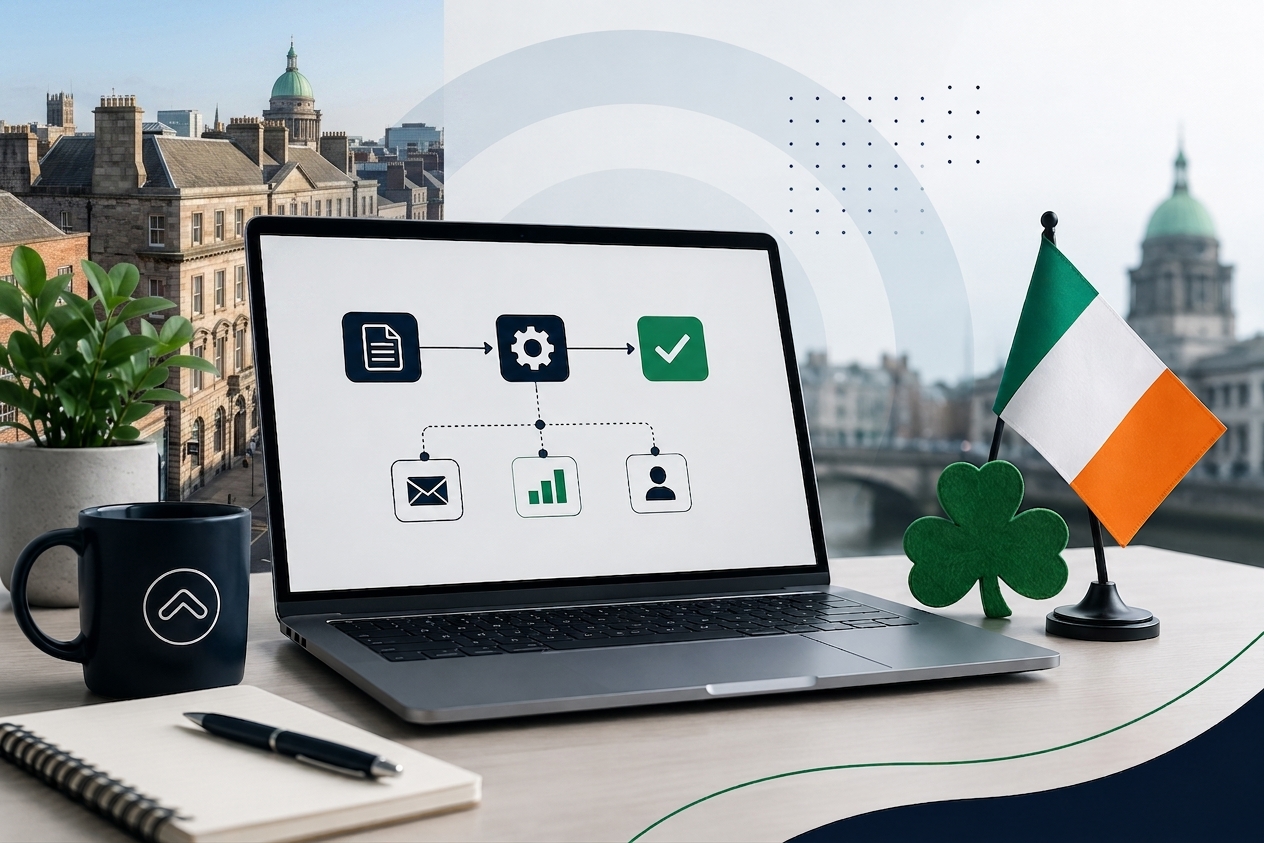
For example, when a customer submits an enquiry through a website, an automated workflow could:
Capture the customer's information
Add the lead to a CRM
Send a confirmation email
Notify the relevant sales team
Create a follow-up task
Update the customer's status
Rather than relying on employees to complete each step manually, the workflow can handle much of the process automatically.
This allows employees to spend more time on activities that require decision-making, creativity, communication, and strategic thinking.
Why Is Business Process Automation Important for Irish Businesses?
Businesses across Ireland operate in increasingly competitive markets. At the same time, companies are dealing with rising operational costs, growing customer expectations, and the need to do more with existing resources.
Automation can help address these challenges by improving the way everyday processes are managed.
One of the biggest advantages is that automation does not necessarily require a business to completely replace its existing systems. Instead, automation technologies can often connect the tools a company already uses and make them work together more efficiently.
For example, a business may already use Microsoft 365, a CRM, accounting software, online forms, and communication platforms. Automation can connect these systems so that information moves between them without requiring employees to repeatedly enter the same data.
Key Benefits of Business Process Automation
1. Save Time on Repetitive Tasks
Employees often spend hours performing repetitive administrative activities.
Copying information between spreadsheets, sending routine emails, creating reports, entering customer information, and updating records may not require complex decision-making, but they can consume a significant amount of working time.
Automation allows these repetitive activities to happen automatically.
The result is more time for employees to focus on customers, business development, problem-solving, and other important responsibilities.
2. Reduce Human Error
Manual data entry and repetitive processes can lead to mistakes.
A missed email, incorrect spreadsheet entry, duplicated record, or forgotten follow-up can create unnecessary problems for a business.
Automated workflows follow predefined rules consistently. This can reduce the risk of errors caused by repetitive manual work.
For businesses handling large volumes of information, this consistency can be particularly valuable.
3. Improve Operational Efficiency
Automation is not simply about completing tasks faster. It can also improve the way processes are structured.
When a business maps out a workflow and identifies unnecessary steps, delays, and bottlenecks, it can redesign the process before automating it.
This creates an opportunity to make operations more efficient rather than simply transferring inefficient manual processes into software.
4. Improve Customer Experience
Customers expect businesses to respond quickly.
Automation can help businesses send immediate confirmations, route enquiries to the right team, trigger follow-up communications, and keep customer information updated.
For example, an automated lead management process can ensure that a new enquiry does not remain sitting in an inbox for several hours.
Faster and more consistent responses can contribute to a better customer experience.
5. Make business Processes More Scalable
A manual process that works for 20 transactions may become difficult to manage when the business handles 200 or 2,000.
Automation allows businesses to handle increasing volumes without necessarily increasing administrative workload at the same rate which mean business automation boost ROI.
This makes automation particularly useful for growing Irish businesses that want to scale while maintaining operational efficiency.
What Processes Can Businesses Automate?
Almost any repetitive and rules-based process can potentially be automated.
However, the best opportunities usually involve tasks that are repetitive, time-consuming, predictable, and involve multiple systems.
Common examples include:
Lead Management
When a potential customer submits a form, automation can capture the information, update a CRM, notify a salesperson, and schedule a follow-up.
Invoice Processing
Automation can help collect invoice information, route invoices for approval, update accounting systems, and notify relevant employees.
Employee Onboarding
New employee information can trigger a series of automated tasks, including account creation, document collection, training notifications, and internal communications.
Customer Support
Automation can categorise enquiries, assign tickets, send acknowledgement emails, and escalate certain requests to the appropriate team.
Reporting
Businesses can automate the collection of information from different systems and generate recurring reports without manually gathering the data every time.
Document Management
Automated workflows can organise documents, move files between folders, request approvals, and notify employees when actions are required.
Power Automate and Business Workflows
Microsoft Power Automate is one of the technologies businesses can use to create automated workflows between applications and services.
A Power Automate workflow can connect different systems and trigger actions based on specific events.
For example:
Trigger → Action → Condition → Action
A new form submission could trigger a workflow that creates a CRM record, checks whether the lead meets certain criteria, sends an email, and alerts a member of the sales team.
Businesses interested in implementing this approach can learn more in our guide:
How to Build an Effective Power Automate Workflow
The advantage of workflow automation is that businesses can create repeatable processes without requiring employees to manually coordinate every step.
The Role of Automation Technology
Business process automation is part of a broader shift towards digital operations.
Modern automation technology can combine workflow automation, cloud platforms, artificial intelligence, data integration, and business applications to create more connected processes.
For Irish businesses, this can mean moving away from isolated systems and towards workflows where information flows automatically between different platforms.
For a deeper look at this topic, read:
How Automation Technology Is Changing Irish Businesses
The goal is not simply to automate everything. Instead, businesses should identify where technology can provide the greatest operational value.
Automation Trends Irish Businesses Should Watch
Automation is continuously evolving.
Technologies that were previously available mainly to large organisations are becoming increasingly accessible to small and medium-sized businesses.
Cloud-based platforms, AI-powered tools, workflow automation, and system integrations are changing how businesses approach everyday operations.
Keeping up with developments in the sector can help organisations identify new opportunities to improve their processes.
For businesses that want to stay informed, our latest guide covers:
Automation News and Trends to Watch in 2026
Understanding emerging automation trends can help businesses make better decisions about which technologies are worth adopting.
What Is the Difference Between Automation and Digital Transformation?
Automation and digital transformation are related, but they are not exactly the same.
Automation focuses on improving specific tasks or processes by reducing manual work.
Digital transformation is broader. It involves changing how an organisation operates and delivers value through digital technologies.
For example, automating invoice approvals is a business process automation project.
Moving an entire finance department from disconnected manual systems to an integrated digital platform could form part of a broader digital transformation strategy.
Automation can therefore be one component of a larger digital transformation programme.
National Automation and the Dublin Business Market
Dublin is one of Ireland's most important business and technology centres, with organisations across professional services, technology, finance, retail, healthcare, and other sectors looking for ways to improve operational efficiency.
Businesses exploring automation may encounter providers and solutions associated with national automation and the Dublin market.
Understanding the available approaches can help businesses evaluate whether automation is suitable for their own processes.
Our dedicated article explores this subject in more detail:
National Automation Dublin: What Businesses Need to Know
For companies operating in Dublin, automation can be particularly useful when different teams need to share information across multiple systems.
How to Identify Processes That Should Be Automated
Not every process needs automation.
Before investing in an automation project, businesses should identify processes where automation can provide measurable value.
A good candidate typically has several of the following characteristics:
It is performed frequently.
It involves repetitive manual actions.
Employees need to enter the same information more than once.
The process involves multiple applications.
There are frequent delays.
Human errors occur regularly.
Employees spend significant time on administrative work.
The process follows predictable rules.
The business wants to handle greater volumes without increasing administrative workload.
A simple process audit can help identify these opportunities.
Start by listing recurring processes across departments and documenting each step. Then identify where employees spend the most time or where errors and delays occur.
These areas can become candidates for automation.
Business Process Automation Services
Some organisations have the internal resources to design and implement automation themselves. Others may benefit from working with an experienced automation partner.
Business process automation services can help organisations analyse existing workflows, identify automation opportunities, design automated processes, integrate systems, and monitor performance.
The right approach depends on the size of the organisation, the complexity of its systems, internal technical expertise, and the processes being automated.
Businesses can also explore how automation services can contribute to measurable operational improvements:
How Business Process Automation Services Improve Efficiency
How to Approach an Automation Project
A successful automation project should begin with the business problem rather than the technology.
Step 1: Identify the Problem
Determine which process is creating the biggest operational challenge.
Is it taking too much employee time? Is it causing errors? Are customers waiting too long for responses?
Step 2: Map the Current Process
Document every stage of the existing workflow.
This helps identify unnecessary steps, bottlenecks, and opportunities for improvement.
Step 3: Define the Desired Outcome
Set a clear objective.
For example:
Reduce processing time
Reduce manual data entry
Improve response times
Reduce errors
Increase productivity
Improve customer service
Step 4: Select the Right Technology
Once the process is understood, businesses can determine which automation platform or technology is appropriate.
The technology should support the business requirement rather than the other way around.
Step 5: Start Small
A pilot project can be a useful way to test automation before implementing it across the organisation.
Choose a process with clear inputs, outputs, and measurable results.
Step 6: Measure the Results
After implementation, track relevant metrics.
These could include:
Hours saved
Processing time
Error rates
Response times
Number of automated tasks
Employee productivity
Measuring results helps determine whether the automation project is delivering the expected value.
Common Mistakes to Avoid
Automation can provide significant benefits, but poor implementation can create new problems.
Automating a Bad Process
If an existing workflow contains unnecessary steps, automating it without redesigning the process may simply make an inefficient process faster.
Automating Everything
Not every task should be automated.
Processes involving complex judgement, sensitive decisions, or frequent exceptions may still require human involvement.
Ignoring Employees
Employees understand how processes work in practice.
Including them during the planning and implementation stages can help identify problems and improve adoption.
Focusing Only on Technology
The goal of automation should be business improvement.
Choosing a platform simply because it has many features does not guarantee a successful outcome.
Failing to Monitor Automation
Automated workflows should be monitored regularly.
Business processes change over time, and an automation that worked perfectly when implemented may need updates as systems, policies, or requirements evolve.
The Future of Business Process Automation in Ireland
Automation is likely to become an increasingly important part of how Irish businesses operate.
As cloud applications, AI, workflow platforms, and integrations continue to develop, businesses will have more opportunities to reduce repetitive work and create connected digital processes.
The most successful organisations will not necessarily be those that automate the largest number of tasks.
Instead, they will be the businesses that identify the right processes, implement appropriate technology, and continuously improve how their systems and people work together.
For Irish SMEs in particular, automation can provide an opportunity to compete more effectively by improving productivity without relying solely on increasing headcount.
Final Thoughts
Business process automation can transform repetitive and time-consuming workflows into efficient, consistent, and scalable processes.
From lead management and customer support to reporting, document management, and invoice processing, automation can help businesses reduce manual work while allowing employees to focus on more valuable activities.
For Irish businesses, the most effective approach is to start with real operational challenges, identify the processes that offer the greatest opportunity for improvement, and then select the technology that fits those requirements.
Whether you are exploring Power Automate workflows, evaluating new automation technology, or considering professional business process automation services, the key is to focus on measurable business outcomes.
At Flexi Boost, we believe automation should be practical, scalable, and aligned with the way a business actually operates. By taking a structured approach, Irish businesses can use automation to improve efficiency today while creating a stronger foundation for future growth.