



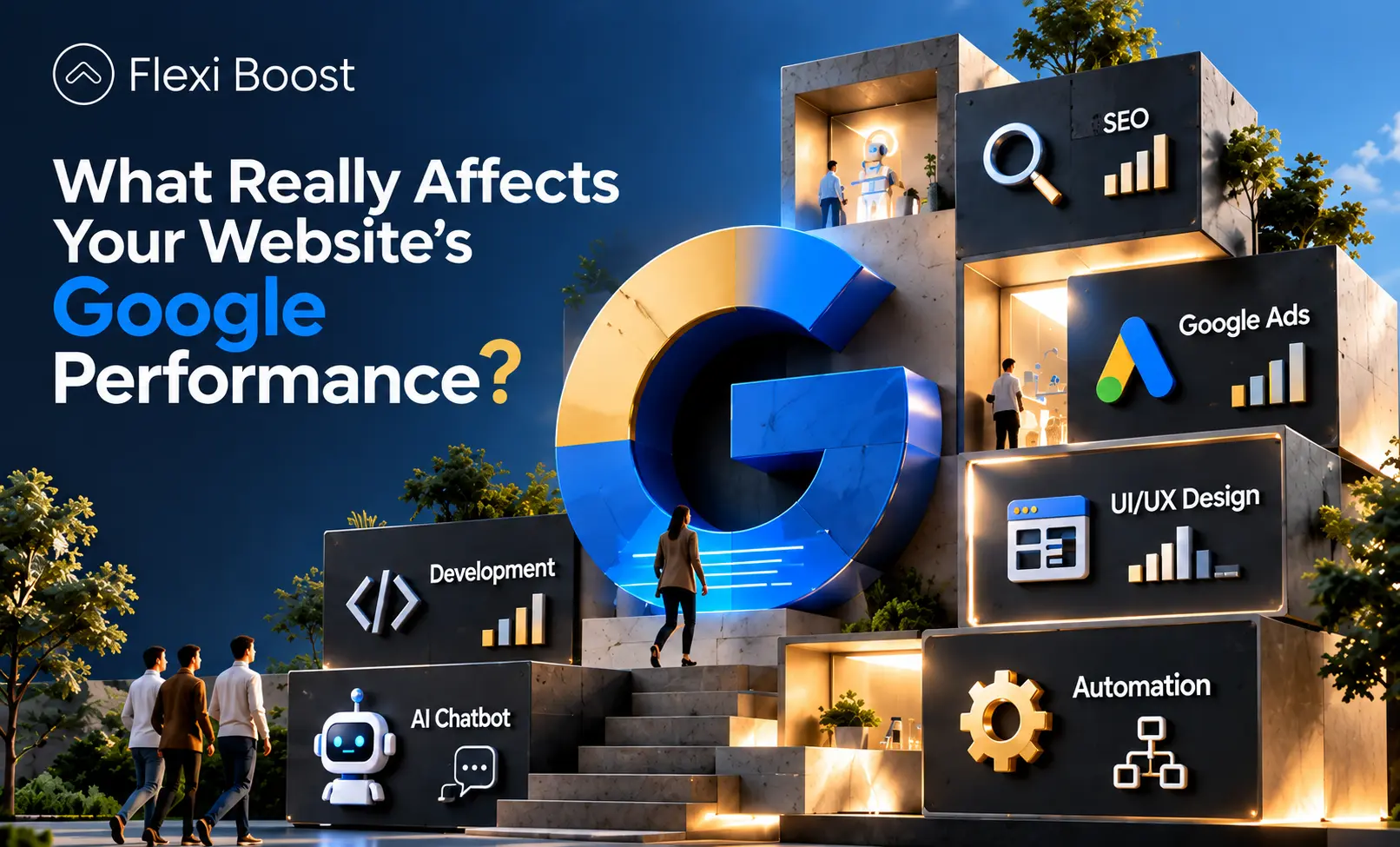

Getting better results from Google is rarely about changing one title, adding a few keywords or building more backlinks. A website's performance depends on several areas working together, from the way Google discovers and understands the site to what happens after a potential customer lands on it.
Some areas, such as SEO, content quality and technical accessibility, can directly influence organic search visibility. Others, including Google Ads, chatbots and automation, do not directly improve organic rankings but can make the traffic reaching your website far more valuable. Understanding that difference helps businesses invest in the right improvements instead of treating every digital service as a Google ranking factor.
Google Does Not Rank Websites Using One Simple Checklist
Google Search uses multiple systems and signals to decide which pages are most useful for a particular search. That means there is no single optimisation that automatically moves a website to the top of the results.
Google also advises website owners not to focus on only one or two aspects of page experience. Content usefulness, relevance, technical accessibility and the overall experience need to work together.
This is why two businesses can make the same SEO change and see very different outcomes. One website may need stronger content, while another is being held back by technical problems, weak authority or pages targeting the wrong search intent.
The better approach is to understand what is limiting the website now, make the right improvements, measure what happens and then decide what needs attention next.
SEO Is the Foundation of Organic Google Visibility
If the objective is to improve organic rankings, SEO remains the foundation.
SEO helps search engines discover, understand and evaluate a website while also making sure the pages match what users are actually searching for. This includes technical SEO, keyword research, search intent, on-page optimisation, internal linking, content development, local SEO and authority building.
The important point is that SEO should not be reduced to a fixed monthly checklist. One website may need technical fixes before content becomes a priority. Another may already have hundreds of pages indexed but need keyword remapping because several URLs are competing for the same searches.
For businesses targeting organic growth, our SEO services focus on identifying those priorities rather than treating every website in exactly the same way.
Content Quality Still Matters More Than Publishing More Content
Publishing more articles does not automatically improve rankings.
Google's own guidance encourages websites to create helpful, reliable and people-first content rather than content produced mainly to manipulate search rankings. It also highlights the value of original information, clear expertise and content that genuinely satisfies the visitor's purpose.
For a business website, this means each important page should answer the questions someone would reasonably have before choosing the company. A service page should clearly explain what is offered, who it is suitable for, how the process works and why the business is credible.
Blogs should then support those main pages rather than compete with them.
For example, a website may have a main SEO service page targeting commercial searches, while supporting articles explain local SEO, technical SEO or how businesses should choose an SEO provider. The content works together as a topic rather than every page trying to rank for the same keyword.
Website Development Can Directly Limit SEO Performance
A strong SEO strategy cannot fully compensate for a website that search engines struggle to crawl or understand.
Development decisions can affect important technical areas such as crawlability, indexation, URL structures, redirects, canonical tags, internal linking and structured data. A website may have useful content but still perform poorly if important pages are accidentally blocked, duplicated or connected through weak site architecture.
Website speed and mobile usability also matter to the overall experience. Large files, excessive JavaScript, unstable layouts and poorly implemented features can make pages more difficult for visitors to use.
This is why website development and SEO should not be treated as completely separate processes. The technical foundation needs to support the search strategy instead of creating problems the SEO team has to repair later.
Page Experience and UX Support the Bigger Picture
A website can rank and still fail commercially.
Imagine a visitor finds your business through Google, clicks the result and lands on a page with confusing navigation, poor mobile design and no obvious next step. The ranking may have generated the visit, but the website has failed to turn that opportunity into a meaningful action.
Google's guidance encourages site owners to think about the overall page experience rather than trying to optimise a single experience metric in isolation.
Good UI/UX design helps visitors understand information, move between pages and complete important actions more easily. Clear layouts, useful navigation, readable content, responsive design and strong calls to action can make the traffic generated by SEO more valuable.
So while an attractive interface alone will not push a page to number one, a poor experience can weaken the overall effectiveness of the website.
Google Ads Does Not Improve Your Organic Ranking
This is one of the most common misconceptions about Google.
Paying for Google Ads does not improve your organic rankings. Google states that investment in paid search has no impact on organic search ranking and that its advertising and organic search systems are kept separate.
That does not mean Google Ads has no relationship with your wider Google strategy.
Google Ads can provide visibility while SEO is developing, help businesses reach high-intent searches quickly and generate useful data around search terms, landing pages and conversions.
For example, if certain commercial searches consistently generate qualified enquiries through paid campaigns, that information can help the business understand customer demand and inform wider content or landing-page decisions.
The important distinction is simple: Google Ads can support your search strategy, but paying Google does not buy organic rankings.
Search Performance Means More Than Rankings
A ranking is only useful if the people reaching the website are relevant to the business.
A page could rank first for a broad informational keyword and generate thousands of visits without producing a single useful lead. Another page could rank lower for a highly commercial search and generate genuine enquiries.
That is why businesses should look beyond keyword positions.
Organic clicks, impressions, conversions, calls, bookings, landing-page performance and the quality of enquiries can provide a clearer picture of whether search visibility is contributing to growth.
This also changes the way SEO decisions are made. The objective should not always be to increase every ranking. Sometimes the better move is to improve the pages already attracting commercially relevant searches.
Local SEO Changes the Picture for Irish Businesses
For many Irish SMEs, national visibility is not the only goal.
A dental clinic in Dublin, for example, needs to appear in front of people who could realistically become patients. A tradesperson may only serve a defined region, while a local retailer may depend heavily on searches around its physical location.
In these situations, Google Business Profile, local relevance, business information, reviews, location pages and local authority become important parts of the wider search strategy.
Our guide to how local SEO helps Irish businesses get found looks more closely at how Google Search and Maps can support local businesses.
The key is matching the search strategy to where the business actually operates instead of chasing traffic from locations that are unlikely to generate customers.
Chatbots Do Not Increase Rankings, but They Can Improve What Happens After the Click
Adding a chatbot to your website does not directly make Google rank the site higher.
Its value comes after the visitor arrives.
A potential customer may have a simple question before they are ready to contact the business. They may want to understand pricing, availability, services or the next step in the process. If the website cannot answer that question easily, the visitor may leave.
A well-designed chatbot can help users find relevant information, guide them towards the right service or collect details when appropriate.
This means the chatbot is not an SEO ranking tool. It is a conversion and customer-experience tool that can help businesses make better use of the traffic they already generate.
That distinction matters.
SEO creates visibility. The chatbot can help turn some of that visibility into conversations.
Automation Makes Leads More Valuable
Automation sits even further away from Google's organic ranking systems, but it can have a major effect on the commercial value of digital marketing.
Consider what happens when a potential customer completes a form.
Without automation, the details may sit in an email inbox until someone notices them. With a properly designed workflow, the enquiry could be added to a CRM, assigned to the right person, trigger an internal notification and send an appropriate confirmation to the customer.
None of those actions improve the page's ranking.
But they improve what happens because the website ranked.
This is where business automation becomes part of the wider growth system. SEO generates an opportunity, the website captures it and automation helps the business act on it efficiently.
A company focusing only on rankings can easily overlook everything that happens after the click.
The Strongest Strategy Connects Every Stage
Instead of thinking about SEO, development, UX, Google Ads, chatbots and automation as isolated services, it is more useful to understand how they can support different stages of the same customer journey.
A potential customer might discover the business through an organic result or Google Ad. The website then needs to load properly, explain the service and provide a clear user experience. A chatbot may help answer a question, while an enquiry form captures the lead. Automation can then move that lead into the company's internal workflow.
The journey can look something like this:
Search Visibility → Website → User Experience → Engagement → Lead → Automation → Sales
SEO and development help make the website discoverable and technically sound. UX helps visitors navigate it. Google Ads can provide additional targeted visibility. Chatbots support conversations, while automation helps the business respond efficiently.
Each area has a different job.
Treating all of them as “ranking factors” misses the bigger picture.
Why Fixing the Wrong Problem Wastes Budget
One of the biggest mistakes businesses make is investing in the wrong area because they have not identified the real problem.
If a website is not being indexed correctly, publishing more articles may not solve the issue. If rankings are strong but leads are weak, additional backlinks may not be the priority. If Google Ads generates clicks but the landing page performs poorly, increasing the advertising budget can simply create more wasted traffic.
The same principle applies across the whole digital strategy.
Before deciding what to invest in, businesses should understand where the current bottleneck is.
Is the website not being found?
Is it being found but not clicked?
Are people visiting but leaving?
Are enquiries arriving but not being followed up effectively?
The answer determines whether the next investment should be SEO, development, UX, advertising, chatbot functionality or automation.
How Flexi Boost Looks at Google Performance
At Flexi Boost, we look at Google performance as part of a wider digital system rather than focusing on rankings alone.
If the problem is technical, development may need attention before additional content is created. If the website already has strong visibility but poor conversions, UX may deserve more investment. If the business needs faster exposure while organic rankings develop, Google Ads may support that objective.
The same thinking applies after the enquiry. If potential customers are reaching the website but the business is slow to respond, a chatbot or automated workflow may create more value than another ranking improvement.
The objective is to identify what is limiting growth and focus the work there.
That approach allows SEO, development, design, advertising and automation to support each other while still recognising that each one affects Google performance in a different way.
Conclusion
Improving your website's Google performance is not about finding one secret ranking factor.
SEO, useful content and strong technical foundations are central to organic visibility, while UX helps visitors use the website effectively. Google Ads can add targeted paid visibility, and chatbots and automation can help businesses turn traffic into real opportunities.
The strongest results come when each part of the digital journey does the job it is actually designed to do.