





Automation can save time, reduce repetitive work and help a business operate more efficiently. But not every automation project produces a positive return.
For Irish businesses, the real question is not simply what can be automated. It is whether the automation creates enough measurable value to justify the cost.
What Are Business Automation Services and How Do They Work?
Business automation services help companies replace repetitive manual tasks with software driven workflows.
Instead of an employee completing every step manually, a system can respond to a trigger and carry out a predefined series of actions.
For example, when someone submits an enquiry through your website, an automated workflow could create a CRM record, send a confirmation email, notify the sales team and schedule a follow up task.
Without automation, those steps may require several manual actions across different platforms.
Good business process automation services usually start by understanding the existing process before choosing any software. This involves identifying repetitive steps, bottlenecks, exceptions and tasks that still require human judgement.
If you want to understand how these workflows are structured, our guide to workflow and workflow automation explains the process in more detail.
Automation also becomes much more effective when your systems can communicate with each other.
A company may use a website, CRM, accounting software, project management platform and email system. If those tools are disconnected, staff may spend hours copying data between them.
This is where business system integrations can help create a more connected automation setup.
Why Irish Businesses Are Investing More in Automation
Irish businesses are using more digital tools, cloud platforms and AI-powered software, making automation easier to introduce than it was a few years ago.
Data from Ireland's Central Statistics Office shows that AI adoption among Irish enterprises continues to grow, while cloud computing is already widely used across businesses.
For SMEs, startups and local businesses, the main reason to invest in automation is usually practical.
Teams want to reduce administrative work, respond to leads faster, improve reporting and avoid hiring people simply to manage repetitive tasks.
Common reasons businesses look at automation include:
Too much manual data entry
Slow lead follow up
Repetitive customer emails
Manual reporting
Disconnected software
Repeated internal approvals
Growing workloads
Administrative bottlenecks
The strongest automation projects normally start with one clear problem.
For a broader look at this topic, see our guide on why automation solutions matter for business growth.

How Automation Services Can Improve Your Business ROI
The value of Automation Services is not limited to saving staff time.
A well designed automation can improve ROI in several different ways.
Reduce Repetitive Work
Many employees spend part of their day completing tasks that follow the same steps every time.
This could include updating CRM records, processing website enquiries, sending reminders, creating reports or moving information between systems.
Automating these activities can free employees to focus on work that requires experience, communication or decision making.
Reduce Manual Errors
Manual data entry creates opportunities for mistakes.
Information can be entered incorrectly, copied into the wrong system or forgotten completely.
Automation can improve consistency when the process follows clear rules.
That reduces the time spent fixing avoidable errors later.
Improve Lead Response Times
A new lead should not have to wait until someone checks an inbox.
Automation can immediately create the lead in your CRM, notify the correct team member and send an acknowledgement to the prospect.
The result is a faster process without requiring someone to monitor every enquiry manually.
Increase Capacity
Automation can also help businesses handle more work without increasing administration at the same rate.
A workflow that manages ten enquiries per week may also be able to manage 100 with only a small increase in operating cost.
For growing Irish SMEs, this can be particularly valuable.
Improve Reporting
Automated workflows can update dashboards and reports as activity happens.
This gives managers better visibility into sales, operations, customer service and internal workflows without waiting for someone to manually prepare a spreadsheet.
When Automation Starts Hurting Your Business ROI
Automation can reduce costs, but it can also create new ones.
The biggest problems usually happen when businesses automate the wrong process.
Automating a Bad Process
If a process is already inefficient, automation may simply make the same problem happen faster.
Before automating anything, ask whether every step is actually necessary.
Sometimes a process should be simplified before it is automated.
Automating Low Value Tasks
A complicated workflow that saves ten minutes per month may never recover its implementation cost.
Automation works best when the task happens frequently enough to justify the investment.
Using Too Many Tools
A simple automation can quickly become expensive when several platforms, subscriptions and integrations are added.
More technology does not automatically mean better results.
Removing Human Judgement
Some tasks should not be fully automated.
Customer complaints, unusual financial decisions and complex enquiries may still need human involvement.
Automation should support employees, not remove people from situations where judgement matters.
Creating Poor Customer Experiences
A badly configured chatbot or automated email sequence may reduce workload while frustrating customers.
That can damage the business even if the workflow technically saves time.
The Hidden Costs of Business Automation
The implementation fee is only one part of the real automation cost.
Businesses should also consider ongoing expenses.
Software Costs
Automation platforms may charge based on users, workflow runs, API requests or premium integrations.
Costs can increase as usage grows.
Integration Costs
Connecting modern systems can be straightforward, but older or custom software may require additional development.
Data Preparation
Automation depends on reliable data.
Duplicate records, missing information and inconsistent formats may need to be cleaned before a workflow can operate properly.
Testing
A workflow should be tested against normal activity and unusual situations.
This may include missing information, duplicate records, API failures or incorrect customer input.
Maintenance
Automation is not always a one time project.
APIs change, software platforms update and internal processes evolve.
Important workflows need monitoring and maintenance.
Training
Employees should understand what the automation does, when they need to intervene and what happens if something fails.
Security and GDPR
If a workflow processes personal data, the business also needs to consider access controls, third party processors, data retention and GDPR responsibilities.
Common Automation Mistakes That Cost Businesses Money
Automation projects often fail because the planning was weak, not because the technology was poor.
Automating Before Mapping the Process
Document the existing workflow first.
You may discover that some steps should be removed rather than automated.
Choosing Software Before Defining the Problem
Do not start with a platform and then search for something to automate.
Start with the business problem.
Then choose the technology.
Automating Too Much at Once
Trying to automate several departments at the same time creates more complexity and more risk.
A smaller pilot makes it easier to test results.
Ignoring Exceptions
Real business processes are rarely perfect.
Customers submit incomplete information, payments fail and systems sometimes go offline.
A good workflow needs a clear way to handle exceptions.
No Human Handover
Automation should know when to stop.
If something requires judgement, the workflow should pass the task to the right person.
No Clear Owner
Someone inside the business should understand and own each important automation.
Without ownership, small issues can continue for weeks without being noticed.
How to Measure the ROI of Automation Services
Automation ROI should be measured using business outcomes rather than simply counting the number of workflows created.
A basic formula is:
Automation ROI (%) = ((Value Generated - Automation Cost) ÷ Automation Cost) × 100
Before implementing automation, measure the current process.
Useful metrics include:
Time spent per task
Number of tasks per month
Staff cost
Error rates
Lead response time
Processing time
Customer support workload
Software costs
Then calculate the full automation cost.
This should include implementation, subscriptions, integrations, support and maintenance.
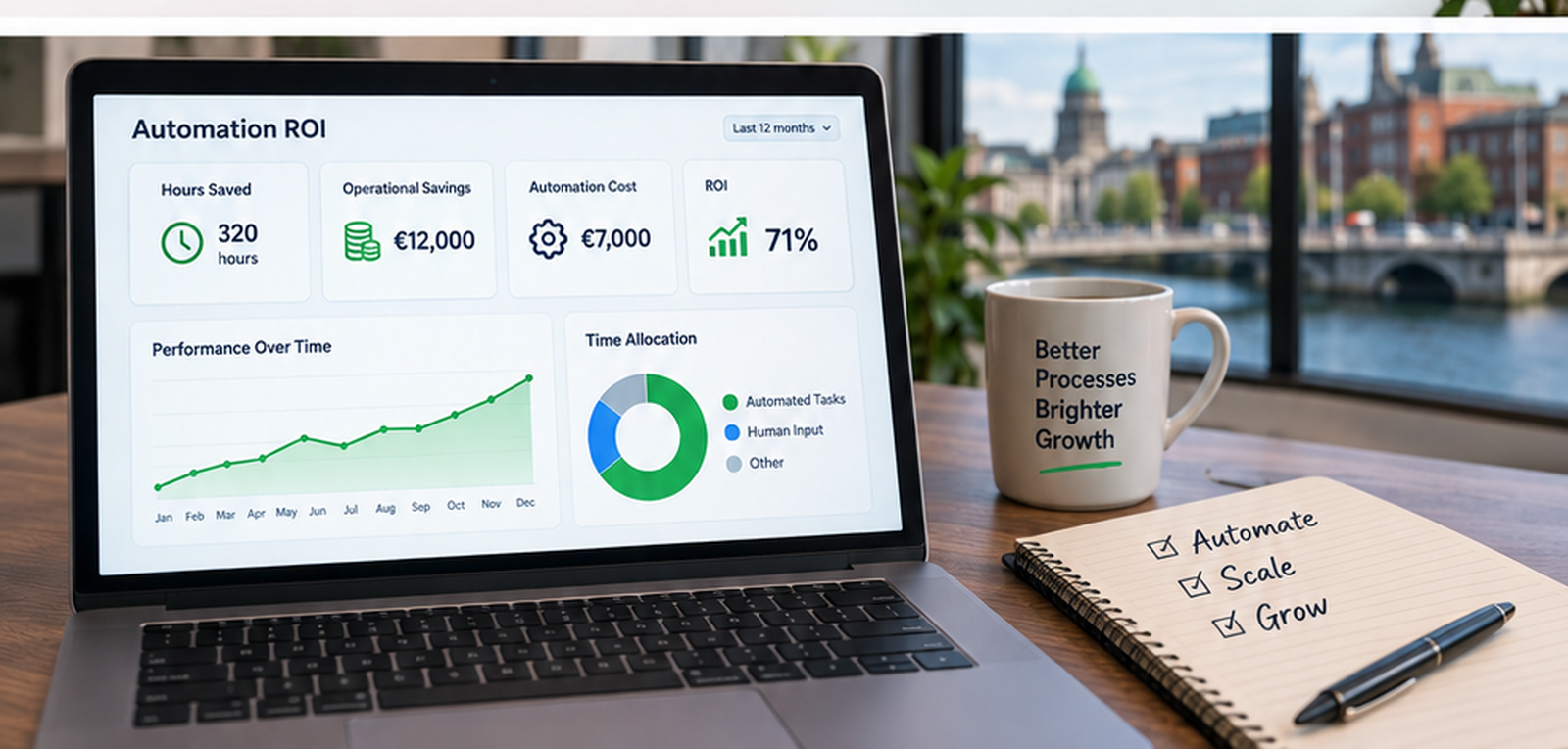
For example, imagine a process that uses 10 staff hours every week.
If the internal cost of that time is €25 per hour across 48 working weeks, the annual cost is:
10 × €25 × 48 = €12,000
If the automation costs €4,000 to build and €250 per month to run, the first year cost would be:
€4,000 + €3,000 = €7,000
If the full €12,000 of saved capacity creates real economic value, the simplified first year ROI would be approximately:
71%
However, time saved does not automatically equal money earned.
The business needs to use that freed capacity productively.
That could mean serving more customers, completing more billable work, reducing overtime or avoiding an additional hire.
How to Choose the Right Automation Service Provider in Ireland
A good automation provider should understand your business process before recommending software.
Before choosing a provider, ask how they approach the project.
Do They Understand the Process First?
The provider should understand the existing workflow, problems and desired outcome before building anything.
Can They Work With Your Existing Systems?
Replacing every platform is rarely realistic.
Your provider should be comfortable connecting your website, CRM, accounting software and other tools where possible.
Reliable business system integrations are often essential when several systems need to share data.
How Will Results Be Measured?
Agree on measurable KPIs before implementation.
These may include time saved, faster lead response, reduced errors or lower administrative costs.
What Happens When Automation Fails?
Ask how the workflow will be monitored and how your team will be notified if something stops working.
Is Documentation Provided?
Your business should understand what has been built, what systems are connected and who owns the workflow.
How Is Data Protected?
If personal data is involved, ask where the information is stored and which third party platforms process it.
Can You Start Small?
For many SMEs, the best approach is to automate one useful process first.
Measure the result before expanding.
You can explore more examples on our Business Automation Services page.
Conclusion
Automation can improve ROI when it removes repetitive work, reduces errors and supports growth.
But the wrong automation can add cost and complexity. Start with a clear business problem, measure the current process and automate only where the numbers make sense.